Shattering the 2030 Outlook
Jonathan: Emily, the Q2 SEIA report showed a staggering 57.6 GWh of new energy storage installed in 2025 alone, and a record breaking 9.7 GWh installed in Q1 2026. Looking back five years, did SEIA anticipate this level of acceleration, or has the market outpaced even your most optimistic projections?
Emily: The projection in our Q1 2026 Energy Storage Market Outlook is over 610 GWh by 2030, which far exceeds our expectations from a couple of years ago. Despite ongoing policy uncertainty, tariff fluctuations, and changes in federal funding and incentives, a combination of supply- and demand-side factors have proven the necessity for continued deployment of energy storage. In many ways, SEIA anticipated the hugely important role of energy storage in meeting demand and maintaining grid stability. Last January, SEIA published its Vision for Energy Storage that provided a roadmap for the United States to reach 700 GWh of energy storage by 2030. We remain optimistic about the rapid growth in both the manufacturing and deployment of energy storage over the next four years.
Jonathan: We see a forecast of 610 GWh by 2030—up from even the Q1 2026 projection of 601 GWh. In your view, what is the single biggest ‘bottleneck’ that could prevent us from hitting that 610 GWh milestone?
Emily: There are a number of market and policy factors – including restrictive federal, state, and local policies – that could impact the timeline for reaching 610 GWh. SEIA is tracking 457 solar and storage projects with permits pending that could be vulnerable to politically motivated delays. Many of these changes are ideologically-driven or rooted in misinformation and create costly and burdensome requirements for projects that support energy reliability, alleviate grid congestion, and reduce ratepayer costs.
Securing the Supply Chain
Jonathan: The infographic highlights that the U.S. is now the 2nd largest battery manufacturer in the world, with 131 GWh of cell capacity currently under construction. At Alsym, we think a lot about supply chain resilience. As we scale, how concerned is SEIA about our continued reliance on specific raw materials, and do you see the industry diversifying its chemistry mix to mitigate these risks?
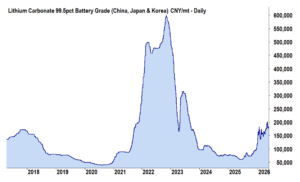
Emily: From a supply chain security perspective, it is important to limit single source risk. This risk mitigation should be undertaken at both the company- and industry-wide levels. Currently, the majority of batteries deployed on the grid in the United States are lithium iron phosphate (LFP) chemistry, with the cathodes being LFP and the anodes being graphite. In recent years, we’ve seen a trend of LFP battery cell manufacturers seeking to diversify and secure their supply chains for these materials by entering direct sourcing agreements with lithium companies, investing in domestic upstream producers, and adjusting procurement strategies to source outside a concentrated geographical area. We’ve also seen a lot of government –efforts aimed at addressing bottlenecks in the mining and processing of raw and precursor materials for battery production. Expanding the menu of battery technologies is integral not only for serving new demand-side applications but also limiting supply chain risks that come with overdependence on one type of technology and set of inputs.
Jonathan: With 23 states now having storage factories online or under construction, we’re seeing a ‘Battery Belt’ emerge. How much of this domestic manufacturing boom do you attribute to the Inflation Reduction Act (IRA) versus organic market demand and how does the OBBB impact this?
Emily: A combination of policy and market factors has contributed to the growth of domestic battery manufacturing. On a global scale, it is worth noting that battery energy storage costs have fallen by more than 90 percent between 2010 and 2024,[1] and between 2024 and 2025 alone, prices for stationary battery packs declined approximately 45 percent to $70/kWh.[2] This global drop in prices for lithium-ion batteries—driven by technological improvements, economies of scale, and increased competition—has of course benefitted the economics of storage deployment and created a major demand-side signal that also supports manufacturing investment. And good policy is important. But the main driver of storage growth has been the increased need for affordable, reliable, quick-to-deploy power, which is exactly what storage provides.
The Shift to Longer Duration Storage
Jonathan: The data shows the average battery duration in 2025 is 3 hours. As we move toward a grid with higher renewable penetration, does SEIA see a tipping point where 3 or 4 hours is no longer enough? What role do you see for Long-Duration Energy Storage (LDES) in the 2030 outlook?
Emily: As regions experience higher renewable penetration, BESS with the ability to discharge beyond 3-4 hours will become increasingly important to bridge the gap between periods of renewable generation and reduce the need for curtailment if renewables generate more than is needed for the grid at any given time. Increased storage deployment generally is also making peaks flatter and longer in many markets, meaning that longer duration batteries will be required to cover those periods. Certain LDES solutions are also uniquely suited for deep cycling and long discharge periods that are needed to manage sharp fluctuations in load from AI learning.
A number of states are already recognizing the benefits of LDES and setting procurement targets for utilities. Most recently, Virginia signed a law in April that sets a target of 4.5 GW of LDES for the state by 2045.
Jonathan: 62% of the utility-scale storage capacity installed in Q1 2026 is ‘Standalone.’ This is a significant shift from the days when storage was almost always ‘Solar + Storage.’ What is driving the business case for standalone storage right now?
Emily: While collocated solar + storage remains the quickest and most cost-effective way to add capacity to the grid, the deployment of standalone storage projects has grown in recent years because of projects’ ability to mitigate grid congestion, defer transmission upgrades, and capture revenue streams in multiple power markets. Depending on the region, energy storage assets can also capture multiple revenue streams, including those for fast frequency regulation, operating reserves, black start, and energy arbitrage.
Geopolitics of Storage?
Jonathan: One of the most striking stats in this report is that ‘Red States’ account for 66% of energy storage capacity. This seems to signal that storage has moved past being a ‘green’ initiative to a fundamental ‘grid reliability and economic’ initiative. How does this geographic diversity change the way SEIA advocates for storage in Washington?
Emily: Energy storage addresses key issues that lawmakers in Washington and state capitols across the country are most concerned about: energy affordability, grid security and reliability, and economic growth. We work with lawmakers, regulators and administrators of all political stripes to advance the industry’s interests and make sure that they understand that storage is not a partisan energy source.
Jonathan: California and Texas are obviously leading the pack, but we’re seeing states like Oklahoma and Idaho break into the Top 10. Which ‘dark horse’ state do you think will surprise people in the 2026 report?
Emily: I think people will be surprised to see Idaho highlighted as one of the leading states on the map. It ranks ninth in the country in energy storage deployment, with 1.7 GWh operational. And the growing solar and storage deployment in the state hasn’t been driven by legislation or a renewable portfolio standard but rather market dynamics. The Idaho Public Utilities Commission requires that utilities present integrated resource plans (IRPs) every two years to deploy the least-cost, least-risk energy assets and maintain grid reliability and ratepayer affordability. This requirement has resulted in significant utility investment in solar and storage, with Idaho Power—the state’s largest utility—setting a goal to reach 100% clean energy by 2045. In addition to these utility goals, Idaho’s existing electricity mix—the majority of which is provided by hydropower resources—and low electricity prices have attracted hyperscalers seeking to scale energy-intensive data centers while maintaining clean energy goals. As renewable penetration expands across all market segments in Idaho, BESS is a practical investment to mitigate risk and reduce costs.
Safety and the Rise of Residential Virtual Power Plants
Jonathan: Residential storage grew by 51% in 2025. As batteries move closer to where people sleep and live, safety becomes a paramount concern for consumers. How is the industry addressing the need for non-flammable solutions to maintain this level of consumer trust?
Emily: Safety codes – including NFPA 855 (Standard for the Installation of Stationary Energy Storage Systems) and UL 9540 (Standard for Energy storage Systems and Equipment) – have evolved over the past decade to help installers and manufacturers more effectively mitigate fire risk, and they have proven effective. Both standards have been updated since their initial publication to apply a whole-of-system approach to safety relevant to both utility-scale and residential storage, and non-compliance results in utility prohibitions on grid connection. SEIA works with both public and private sector stakeholders to ensure that codes and standards pertinent to the design, manufacturing, and installation of batteries evolve with these innovations.
Jonathan: With residential deployment expected to increase 120% by 2030, do you see Virtual Power Plants (VPPs) becoming a standard part of the American household’s relationship with their utility?
Emily: We’re seeing more and more states turn to VPPs to strengthen grid reliability and lower electricity costs for ratepayers. Two major markets—California and Texas—have been operating VPP programs for the past several years, and numerous other states have recently moved VPP programs forward.
Given considerations around affordability and load reduction, I expect we’ll see a lot of VPP growth across the country in coming years, especially as states seek to mitigate strain on the grid without pursuing costly transmission upgrades or dirty peaker plants.
The “Guru” Perspective
Jonathan: If you could clear one regulatory or interconnection hurdle today with the wave of a magic wand to help the industry reach that 2030 goal faster, which one would it be?
Emily: Because batteries are relatively new grid assets compared to other forms of generation, they are not compensated for all the services they provide the grid. While some markets allow for revenue stacking, this is not standard practice, and many market structures undervalue BESS or have not implemented reforms to open wholesale markets to aggregated DERs. If energy storage assets were compensated for all the services they provide—not just energy arbitrage but also the various ancillary services, flexible ramping, and other reliability benefits—across all market segments (residential, community, and utility-scale), the industry could overcome many of the barriers to reaching ambitious 2030 goals.
Jonathan: Emily, for those looking at the 78,000+ jobs created in this sector, what is your message to the next generation of engineers and marketers looking to join the energy storage revolution?
Emily: The energy storage industry is full of opportunities for professionals with expertise on everything from engineering and materials science to policy, legal, and marketing. We’re at a particularly interesting time for the U.S. battery industry because of the strong policy and market drivers incentivizing onshoring. We’ve seen significant growth not only in domestic cell and pack manufacturing, but also in the upstream (mining and refining) and midstream space, as well as the sectors that support these operations along the supply chain. As the industry continues to grow, there will be a need for more talented professionals who can design and operate manufacturing equipment, improve the design and efficiency of battery cells, innovate with new chemistries and types of energy storage, and work with policy and regulatory bodies to support storage manufacturing and deployment.
[1] https://www.irena.org/News/articles/2025/Aug/Battery-energy-storage-systems-key-to-renewable-power-supply-demand-gaps
[2] https://about.bnef.com/insights/clean-transport/lithium-ion-battery-pack-prices-fall-to-108-per-kilowatt-hour-despite-rising-metal-prices-bloombergnef/