
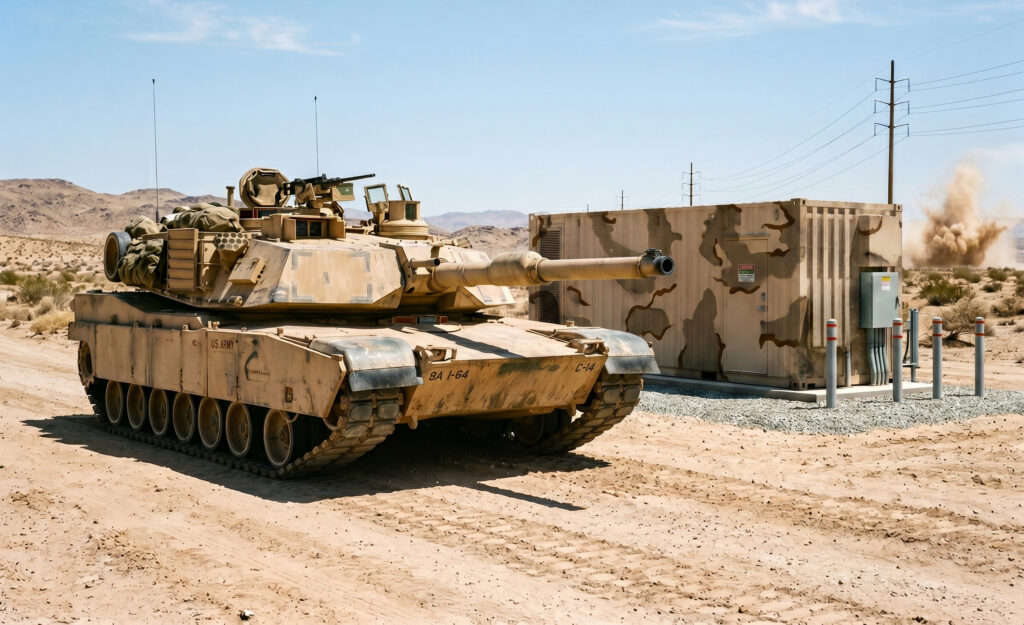
From consumer gadgets to military hardware, battery safety has been a constant topic. While civilian media have shone a bright spotlight on safety incidents in residential and commercial spaces, the safety concerns of battery use in military applications has remained shadowed.
Lithium-ion batteries remain the best choice for some small-scale battlefield applications, but in larger scale deployments like energy storage, battery chemistry evolution is raising the question – should, and can, energy storage technology on the frontline be as robust as an M1A2 Abrams Main Battle Tank? As the U.S. Department of War explores how Lithium-Ion (Li-ion) batteries fail under the significant thermal, mechanical, and electrical stress of abusive conditions, the industry rises to provide a better solution.
The typical battery today, lithium-ion, requires delicate handling and pose five critical risks in a defense context:
- Extreme Temperature Instability: For optimal performance, Li-ion batteries should be operated between 15°C and 35°C and pose safety risks at more extreme temperatures:
- Heat: At above 60°C, the electrolyte begins to decompose, leading to irreversible side reactions. To prevent this, Li-ion batteries require constant, power-intensive thermal monitoring and maintenance to avoid thermal runaway.
- Cold: In temperatures below 0°C, Li-ion’s electrolyte becomes sluggish, severely limiting the battery’s ability to charge or discharge.
- Fire Hazard (Thermal Runaway): A simple penetration from a bullet or shrapnel can puncture the battery, causing it to generate heat and oxygen. This feeds a fire that is extremely difficult to extinguish, often requiring evacuation and a “controlled burn” approach.
- Performance Degradation: Intensive use, extreme temperatures, or frequent cycling accelerate capacity loss over time. This degradation leads to reduced energy storage and backup duration, requiring expensive and repeated investment in system augmentation.
- Constant Monitoring Required: Li-ion systems must be continuously monitored 24/7 for voltage and state of charge (SOC) by systems that must remain energized, even when not in use. Other types of batteries, like sodium-ion batteries, can be stored at a zero state of charge.
- Supply Chain Risk: A majority of the world’s lithium-ion manufacturing capacity and 94% of its production is based in China, posing significant cybersecurity and supply risks for U.S. defense use.
As the domestic battery manufacturing industry matures, there’s a lesser-known alternative maturing to support the use cases where lithium ion fails: sodium ion.
Sodium-ion’s battery chemistry, specifically modified polyanionic types, offers superior performance in extreme temperatures and a better safety profile.
The fundamental advantage is chemical: sodium-ion chemistry with hard carbon anodes allows for the use of propylene carbonate (PC) in the electrolyte instead of the less stable ethylene carbonate, diethyl carbonate, and dimethyl carbonate (EC/DEC/DMC) found in lithium-ion systems. PC’s higher flash point and better thermal stability make the battery significantly less likely to ignite under stress.
Unlike Li-ion, which can enter a self-sustaining thermal runaway, some sodium-ion chemistries remains stable even under severe abuse conditions, including physical damage, overcharging, or extreme temperatures. This stability eliminates the cascading failure mode that makes Li-ion fires so dangerous and difficult to put out.
NFPP+: Non-Flammability and Peak Performance
Standard sodium-ion (NFPP: Na₄Fe₃(PO₄)₂P₂O₇) is a robust and predictable technology offering a wider operating temperature range and good cycle life. This wider range significantly reduces the need for expensive and complex active cooling in high-temperature use cases, like the battlefield.
Alsym’s NFPP+ elevates this technology through proprietary innovations in cell components, including unique electrode dopants and electrolyte additives. These additives further enhance temperature tolerance by preventing the chemical decomposition that triggers thermal runaway. They create a stable electrochemical environment that resists breaking down and prevents the battery from generating the oxygen needed to fuel combustion.
Through repeated innovation, NFPP+ can now deliver:
- Non-flammability. (No thermal runaway risk.)
- Excellent cycle life (>10,000 cycles).
- Fast charge/discharge and high round-trip efficiency.
- Best-in-class energy density for NFPP sodium-ion (250 Wh/L).
See Defense Industry page about NFPP+’s application for the military.